
How to Select a Differential Pressure Switch for HVAC Applications
How to Select a Differential Pressure Switch for HVAC Applications
 Dwyer Series ADPS Adjustable Differential Pressure Switch — the most widely specified DP switch for HVAC filter and fan monitoring in Malaysia. Image courtesy of Dwyer Instruments / DwyerOmega.
Whether you are commissioning a new air handling unit, maintaining a chiller plant, or retrofitting an existing building management system, the differential pressure switch is one of the most critical — and most misunderstood — components in any HVAC installation. Choose the wrong one, and you risk nuisance tripping, missed fault detection, or premature equipment failure. Choose the right one, and it reliably protects your system for years with minimal maintenance.
With over 25 years of experience supplying instrumentation to contractors, system integrators, and facilities teams across Malaysia, we have seen every common selection mistake. This guide will walk you through exactly what to look for.
What does a differential pressure switch actually do?
A differential pressure (DP) switch monitors the pressure difference between two points in a system and triggers an electrical output — either opening or closing a circuit — when that difference crosses a set threshold.
In HVAC, the most common applications are filter condition monitoring, fan and blower proof of flow, pump and chiller protection, and clean room pressurisation control in hospitals, labs, and semiconductor fabs.
 Series EDPS
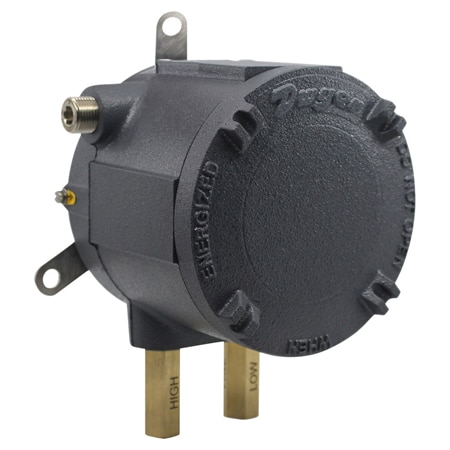 Series AT-ADPS
Dwyer ADPS, EDPS, and AT-ADPS series — three variants covering standard HVAC, UL-listed, and hazardous-area applications. Images courtesy of Dwyer Instruments / DwyerOmega.
Step 1: Identify the pressure range you need
This is the most critical parameter. Selecting a switch with too wide a range means you lose sensitivity at the low end. Selecting one with too narrow a range risks damaging the sensing element or causing constant false trips.
| Application | Typical DP range |
|---|---|
| Air filter monitoring (AHU) | 25–500 Pa (0.1–2.0 in. w.c.) |
| Fan proof of operation | 50–750 Pa (0.2–3.0 in. w.c.) |
| Duct static pressure | 250–2,500 Pa (1–10 in. w.c.) |
| Chilled water pump proof of flow | 10–200 kPa (1.5–30 psi) |
| Clean room pressurisation | 5–100 Pa (0.02–0.4 in. w.c.) |
Step 2: Determine the process media
Not all differential pressure switches are built for all media. In HVAC you will typically encounter air or gases for AHU, duct, and filter monitoring; water or liquids for chilled water, condenser water, and cooling tower circuits; and occasionally steam in older district cooling or industrial process plants.
For air applications, most switches use a silicone or neoprene diaphragm with ABS or polycarbonate housings — lightweight and suitable for Malaysian climate. For water applications, look for stainless steel or brass wetted parts to resist corrosion, especially in systems using treated water with biocides.
Step 3: Choose the right electrical output
Differential pressure switches come with several types of electrical contacts. The most common in HVAC is the SPDT (Single Pole Double Throw) configuration, which gives you both a Normally Open (NO) and Normally Closed (NC) contact from a single switch. This flexibility lets you wire for either alarm-on-fault or alarm-on-loss-of-signal. For applications requiring two independent circuits from one switch, specify DPDT (Double Pole Double Throw).
Key electrical specifications to check:
- Voltage rating — most Malaysian BMS systems use 24 V DC or 240 V AC
- Current rating — for BMS inputs a low-current switch (1 A) is sufficient; for direct load switching confirm the contact rating exceeds the load
- Wire entry — confirm conduit entry size matches your cable gland (M20 or ½" NPT are common)
Step 4: Consider the installation environment
Malaysia's climate — high humidity and temperatures consistently 28–35°C outdoors — demands careful attention to enclosure ratings.
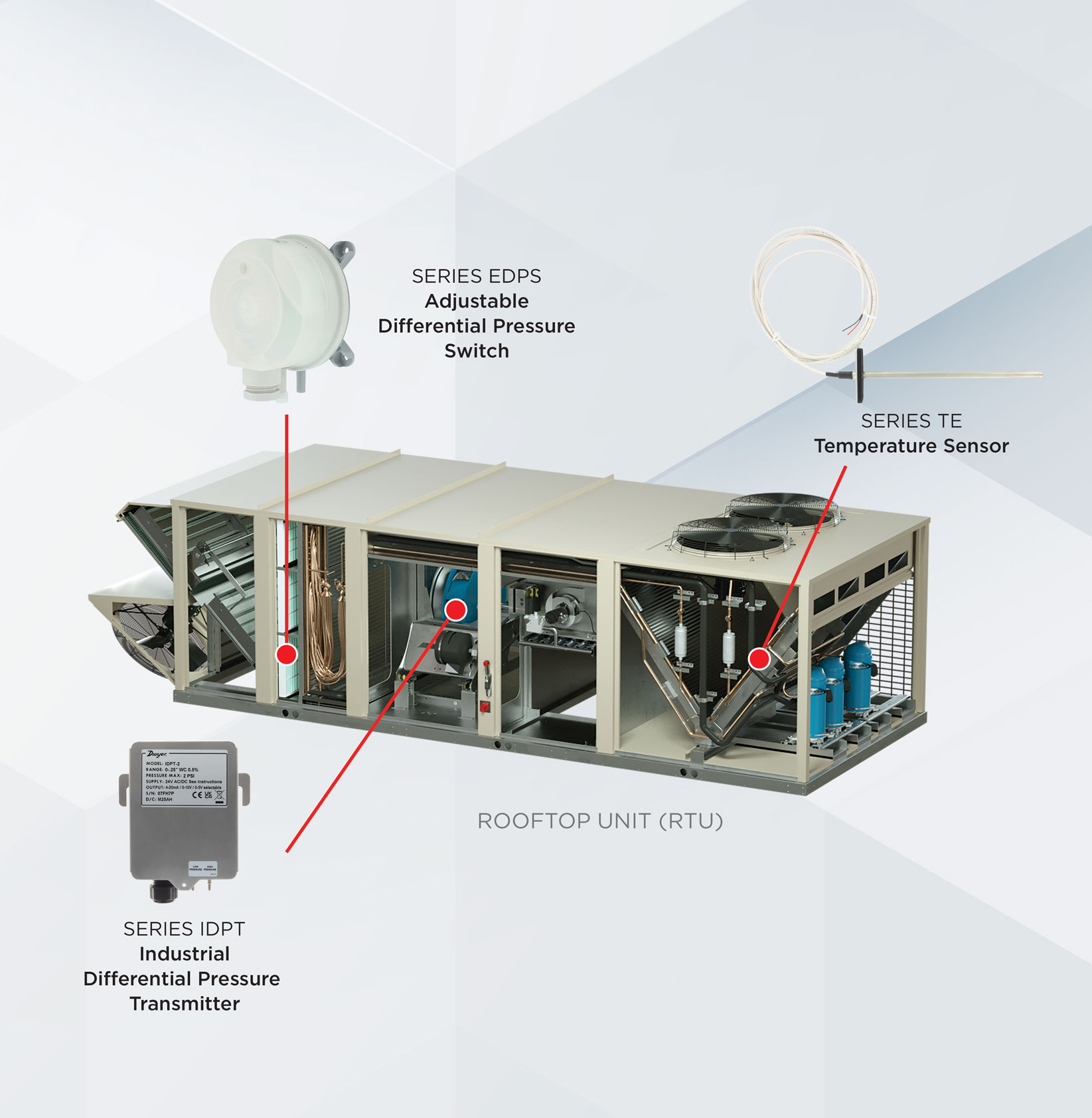 Typical ADPS installation on an RTU. Image courtesy of Dwyer Instruments / DwyerOmega.
| Location | Minimum enclosure rating |
|---|---|
| Indoor air-conditioned (BMS room, AHU room) | IP40 / NEMA 1 |
| Indoor non-air-conditioned (plant room) | IP54 / NEMA 12 |
| Outdoor / exposed (rooftop, cooling tower) | IP65 / NEMA 4 |
| Wash-down areas (food processing, pharma) | IP66 / NEMA 4X |
Step 5: Fixed vs. adjustable set point
Adjustable set point switches are by far the most common in HVAC, allowing the set point to be dialled in on-site to match actual system conditions after the system has been balanced — which is standard commissioning practice in Malaysia. Fixed set point switches are suitable only when the trip point is confirmed at design stage and site tampering must be prevented.
Step 6: Reset behaviour
Automatic reset switches return to their normal state when the differential pressure recovers. They are correct for continuous monitoring applications such as filter condition and fan proof of flow. Manual reset switches require a physical button press after tripping — appropriate for safety-critical applications where a technician must physically attend and investigate before the system can restart, such as HEPA systems in pharmaceutical facilities or hospital operating theatres.
Quick selection checklist
- Expected differential pressure at normal operation
- Trip set point (alarm or shutdown threshold)
- Process media — air, water, or other
- Electrical output required — NO, NC, SPDT, or DPDT
- Supply voltage to the switch
- Enclosure IP rating for the installation location
- Ambient temperature range
- Hazardous area — ATEX or IECEx required?
- Automatic or manual reset
- Process connection types and sizes
Need help selecting the right switch?
Our team of experienced engineers is happy to review your application and recommend the most suitable product. As a certified Dwyer distributor in Malaysia for over 15 years.
Contact our teamFor applications requiring remote monitoring and integration with IoT platforms or Building Management Systems, ask us about pairing your DP switch with Milesight digital input sensors and LoRaWAN gateways for wireless, cloud-connected monitoring without additional control wiring.